Biodiversity: the “hidden” engine of our planet
For long, greenhouse gas emissions have been the focal point of sustainability. However, there are other key elements that compose our planetary systems that deserve as much attention — and biodiversity is certainly one of them.
It refers to the variety of genes, species and ecosystems on Earth, influencing the interactions of billions of living beings. For humans, biodiversity not only has an intrinsic value, but it is also deeply connected to the cultural, regulating and provisioning services from nature.
Despite that, societal values and behaviours have already put more than one million species of plants and animals — of the eight million estimated to exist — at risk of extinction. Such biodiversity loss has profound consequences for our society and is directly driven by five factors (in order of impact):
- Changes in land and sea use
- Direct exploitation of organisms
- Climate change
- Pollution
- Invasion of alien species
According to the Intergovernmental Science-Policy Platform on Biodiversity and Ecosystem Services (IPBES) — the main independent intergovernmental body for biodiversity and ecosystem services — the intensity of these drivers differs regionally, ultimately underpinned by factors such as production and consumption patterns, trade, and technological innovations.
With time, this context has become undeniably material for companies. The World Economic Forum (WEF) estimates that more than half of the world’s GDP is moderately or heavily dependent on nature. If enterprises continue to operate in unsustainable ways, they will feed a vicious circle where not only the multiple consequences of biodiversity loss become more intense, but also their operations become more fragile.
Impact Labs is committed to changing this system and helping organisations operate within the boundaries of our planet. With offers such as biodiversity trainings and footprints, we are leading the transition to a nature-positive economy.
References
Biodiversity. Queensland Government, 18/07/2025.
What are ecosystem services? European Environment Agency, 18/12/2025.
What is biodiversity and why is it important to preserve it? European Environment Agency, 17/11/2025.
Facts about the nature crisis. UN Environment Programme, 28/04/2025.
Global Assessment Report on Biodiversity and Ecosystem Services. IPBES, 2019.
Nature Risk Rising: Why the Crisis Engulfing Nature Matters for Business and the Economy. World Economic Forum, 2020.
The methodological assessment report on the impact and dependence of business on biodiversity and nature’s contributions to people: Summary for policy makers. IPBES, 08/02/2026.
Impact Labs x Darwin: Scaling the Nature-Positive Transition
As previously mentioned, there is strong case for companies to go beyond GHG emissions, especially when assessing their environmental impacts. Without accounting for broader elements, such as land use changes and water consumption, these assessments become limited — restricting the capacity to further understand the nature-related risks, dependencies and opportunities.
Impact Labs and its technology partner Darwin Data are implementing a methodology to measure biodiversity impact with rigour and transparency. Darwin’s platform combines advanced technologies with impact and lifecycle databases to scale nature strategies – including biodiversity footprinting, risk assessments, spatial analysis and reporting.
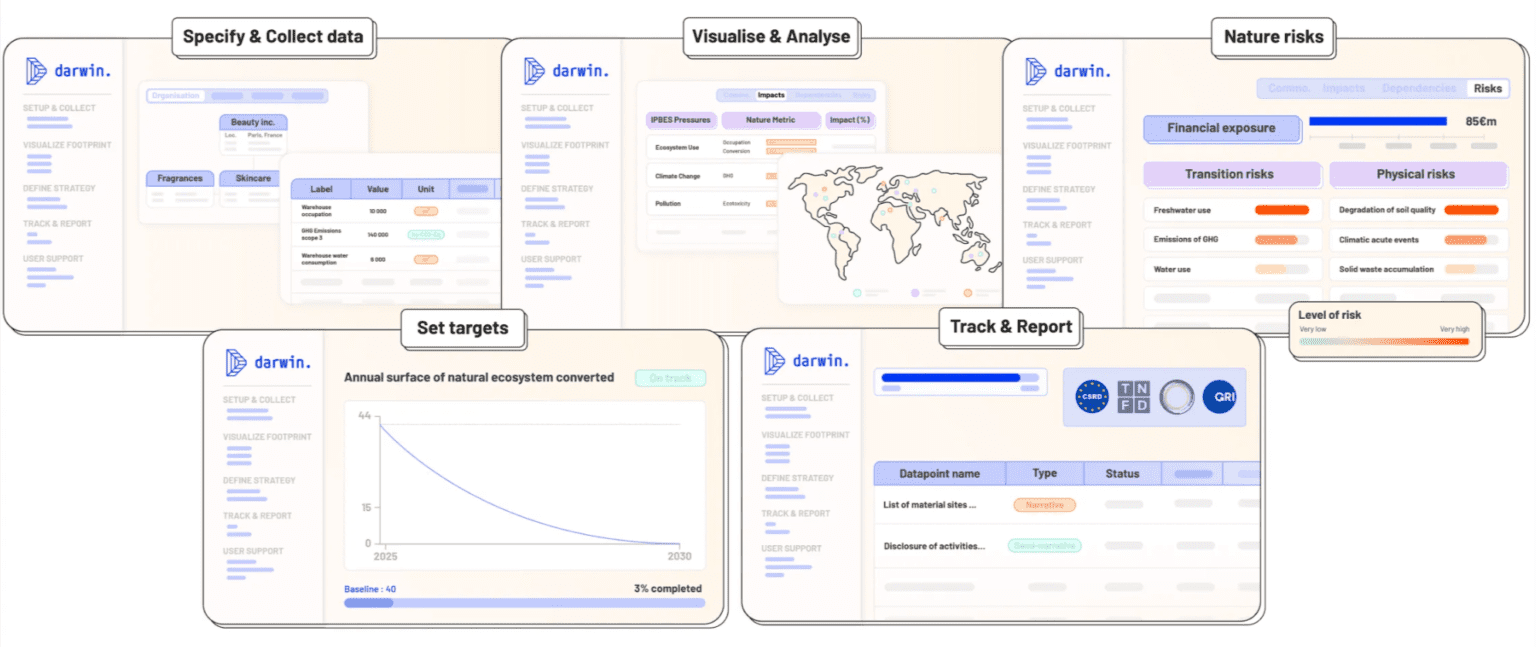
The process starts with mapping all entities related to the organisation, and associating to them the datapoints necessary to analyse the impact on biodiversity. There are several possible data sources — e.g. financial, commodities/product and pressure — which should be combined with the entities’ location to better assess how the company affects local environmental pressures and its proximity to high-risk/sensitivity areas.
Then, the platform will convert this data into both pressure metrics, related to the five drivers of biodiversity loss, and a unified score of biodiversity impact using relevant models and datasets. With this information, it is possible to identify the most significant impacts of the organisation’s operation, its net/avoided impact and other relevant outputs that are particular to the scope of each assessment.