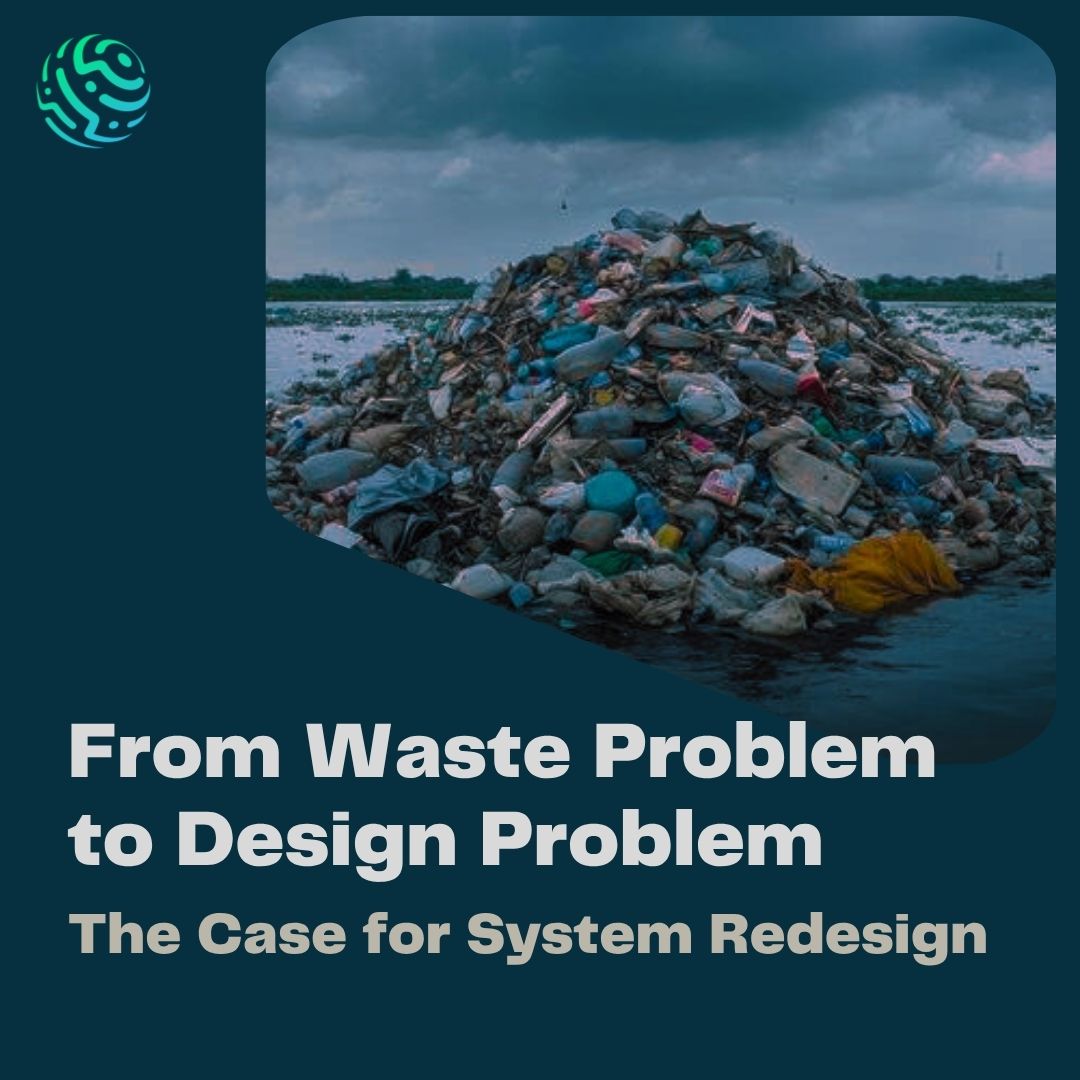
Waste is accelerating at a pace the planet can no longer absorb.
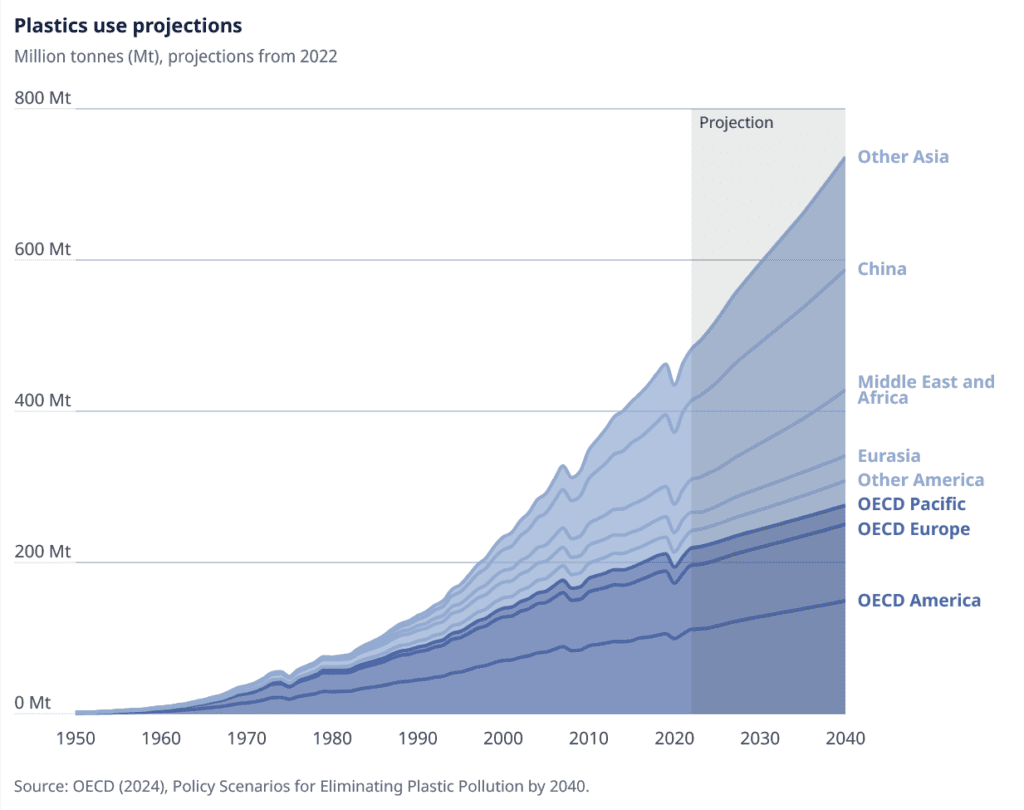
Global waste generation continues to rise sharply, driven by production and consumption systems that remain overwhelmingly linear. Plastic waste alone now exceeds 400 million tonnes per year, and projections suggest this could nearly triple by 2060 if current trends continue. At the same time, less than 10% of plastic is effectively recycled globally, the rest is landfilled, incinerated or leaked to the environment.
Meanwhile, the global circularity rate has declined from 8.6% in 2022 to 6.9% in 2025, signaling that material use is becoming more linear, not less — despite growing technological and policy attention.
This trajectory is increasingly incompatible with Earth system stability. According to the updated Planetary Boundaries framework (2023), 7 out of 9 boundaries are now transgressed. Among them, pollution-related pressures are particularly visible in three critical domains:
First, novel entities (chemical and plastic pollution): the most clearly exceeded boundary. Synthetic chemical production now exceeds the planet’s capacity to safely absorb and process these substances. Microplastics are no longer confined to oceans: they are present in soils, freshwater systems, air, and even human blood. This represents a persistent, accumulating disruption to Earth system functioning, where materials do not degrade but instead accumulate across food chains and ecosystems.
Second, biogeochemical flows (nitrogen and phosphorus cycles): heavily driven by industrial agriculture. Human activity has more than doubled the natural nitrogen cycle, with around 120 million tonnes of nitrogen applied annually through fertilizers. A large share is lost to waterways and the atmosphere, causing eutrophication, oxygen-depleted “dead zones” in oceans, and large-scale freshwater ecosystem collapse.
Third, biosphere integrity (biodiversity loss): strongly amplified by land use change, pollution, and ecosystem degradation. Monitoring data indicates an average ~69% decline in vertebrate populations since 1970, reflecting systemic ecological breakdown rather than isolated species loss.
These pressures are interconnected. Pollution is not only an output of the system — it is actively destabilizing the biophysical conditions that allow ecosystems to regenerate. The consequence is not linear degradation, but increased risk of tipping points, where ecosystems shift abruptly and irreversibly.
At the core of this issue lies a structural problem: the linear economic model. The dominant take–make–dispose logic was built for a world without planetary constraints. Today, it is fundamentally misaligned with the finite nature of Earth’s systems.
This is why incremental improvements are no longer sufficient. The system itself must be redesigned.
The framework developed by the Ellen MacArthur Foundation provides a clearer alternative through its “butterfly diagram.” It proposes a clear frame for a circular economy, integratingtwo regenerative cycles:
- A biological cycle, where materials are designed to safely return to nature without toxicity or accumulation
- A technical cycle, where materials are kept in continuous use through reuse, repair, refurbishment, and recycling at highest possible value
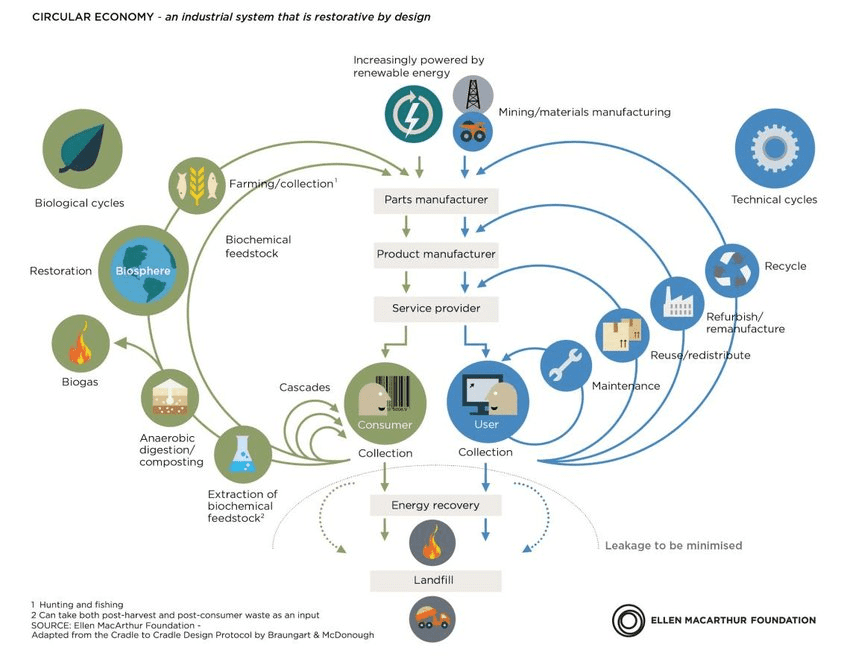
This is not an efficiency upgrade. It is a fundamental redesign of material flow architecture — from linear extraction and disposal to circular regeneration. In this model, waste is not better managed; it is eliminated at the design stage.
In this series, we’ll explore how pollution, waste, and circularity intersect with business transformation. Today’s post sets the stage for understanding why this boundary is so central to a nature positive future.