
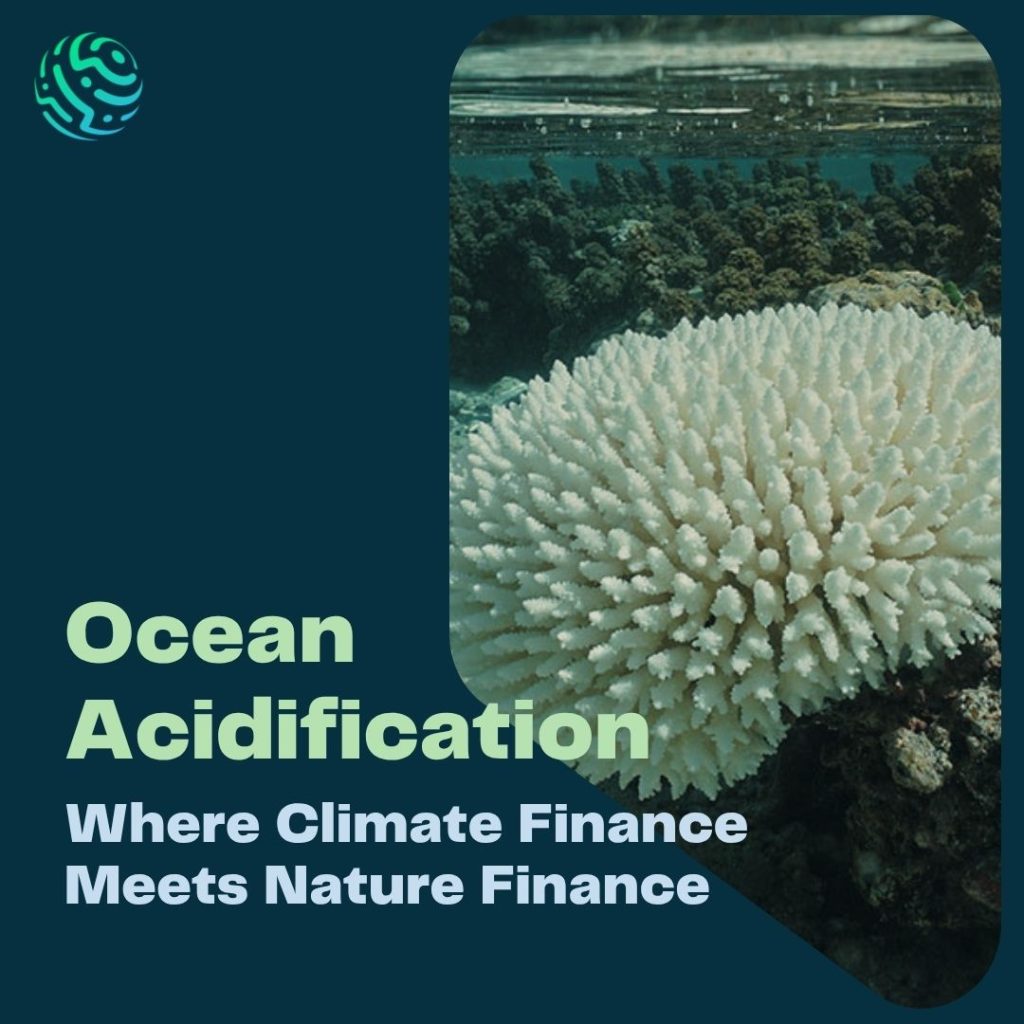
When we discuss the climate crisis, the conversation often revolves around rising temperatures, extreme weather and melting ice. But another profound transformation is taking place beneath the surface: we are changing the chemistry of the ocean.
The ocean absorbs a substantial share of the carbon dioxide released by human activities. This slows the accumulation of CO₂ in the atmosphere and therefore moderates global warming. But it also comes at a cost: as CO₂ dissolves in seawater, it alters ocean chemistry, lowers pH and reduces the availability of carbonate ions that many marine organisms need to build shells and skeletons.
In 2025, the Stockholm Resilience Centre formally assessed ocean acidification as the seventh planetary boundary to have been transgressed, meaning that human activity has pushed this Earth-system process beyond its defined safe operating space.
Yet ocean acidification presents a particular challenge for nature finance: there is no separate financial instrument that can solve it at its root.
The fundamental driver is atmospheric CO₂. To slow global ocean acidification, we ultimately need to reduce greenhouse gas emissions. In that sense, climate finance is also ocean finance: investments in decarbonisation, renewable energy, energy efficiency and low-carbon industrial systems contribute directly to protecting ocean chemistry.
But this is only one side of the equation.
The Ocean Finance Gap
While reducing CO₂ is essential to addressing the root cause of ocean acidification, marine ecosystems are simultaneously under pressure from overfishing, habitat degradation, pollution, warming and other human activities. These pressures can interact with acidification, reducing ecosystem resilience and increasing risks to biodiversity, food security and coastal economies.
And here, the financing gap is substantial.
The 2025 Ocean Protection Gap estimates that only $1.2 billion currently flows annually to marine protection, compared with approximately $15.8 billion needed each year to deliver the global ambition of protecting and conserving at least 30% of the ocean by 2030. This represents an estimated $14.6 billion annual gap.
Importantly, this figure should not be interpreted as the amount of money required to “solve” ocean acidification. Rather, it represents the scale of financing required to establish and effectively manage ocean protection at the level needed to conserve marine biodiversity.
The distinction matters.
Ocean acidification requires climate finance to address its root cause. Marine conservation requires nature and ocean finance to protect ecosystems from the multiple pressures they face. And coastal communities require adaptation finance to manage the impacts that can no longer be avoided.
These are not separate challenges. They are interconnected components of the same transition.
From Climate Finance to Nature Finance
This intersection is increasingly recognised in global policy.
The Kunming-Montreal Global Biodiversity Framework calls for at least $200 billion per year in biodiversity finance from all sources by 2030, including at least $30 billion per year in international finance to developing countries. It also explicitly calls for synergies between finance addressing the biodiversity and climate crises.
The challenge is therefore not simply to mobilise more capital, but to connect existing pools of capital to the environmental outcomes they are capable of delivering.
A renewable energy investment can contribute to reducing the atmospheric CO₂ driving ocean acidification.
A seagrass restoration project can protect biodiversity while preserving carbon stocks and coastal resilience.
A sustainable fisheries investment can improve fish-stock health while supporting livelihoods and food security.
A blue bond can finance marine conservation while creating a mechanism for governments to manage fiscal and environmental risks.
The question is no longer simply how much capital is being mobilised? It is: What environmental outcomes is that capital actually delivering?
Quality Over Quantity: The Ocean Finance Challenge
As with climate finance, mobilising capital does not automatically translate into environmental impact.
Marine conservation provides a particularly clear example. Establishing a protected area on paper does not necessarily mean that biodiversity is being protected in practice. Effective conservation depends on where protected areas are located, what activities are restricted, whether they are enforced, how ecosystems respond and whether local communities are meaningfully involved.
The Kunming-Montreal Global Biodiversity Framework therefore does not simply call for 30% of the ocean to be designated as protected. Its Target 3 calls for at least 30% of coastal and marine areas to be effectively conserved and managed through ecologically representative, well-connected and equitably governed systems by 2030.
This distinction between financial inputs, activities and environmental outcomes is fundamental.
An investor may be able to report:
- €10 million invested in marine conservation;
- 100,000 hectares designated as protected;
- 50 restoration projects financed.
But these figures do not necessarily tell us whether :
- biodiversity has improved;
- fish biomass has recovered;
- ecosystem condition has improved;
- carbon emissions have been avoided;
- coastal resilience has increased;
- or local communities are better off.
In other words, finance alone does not guarantee nature impact. Quantification does.
The Opportunity: Turning Ocean Impact into Investment Intelligence
This creates an important opportunity for financial institutions, investors and companies.
Ocean finance is still an emerging field. The OECD identifies challenges including limited data, a lack of common definitions and standards, relatively small investment ticket sizes, and the need to aggregate projects so that they can meet the requirements of larger investors.
At the same time, innovative mechanisms are beginning to demonstrate how private capital can contribute.
Blue bonds, debt-for-nature swaps, blended finance, conservation funds and outcome-based instruments can help connect financial returns with marine conservation and resilience outcomes. The World Bank highlights blue bonds, debt-for-nature swaps and parametric insurance among the instruments that can help mobilise private capital for ocean conservation and climate resilience.
The opportunity is significant.
The Ocean Protection Gap estimates that investing $15.8 billion annually in ocean protection could generate approximately $85 billion in annual returns and avoided costs by 2050, based on benefits including natural coastal defences, avoided carbon emissions from seagrass loss and the restoration of overexploited fisheries.
But unlocking this opportunity requires more than capital.
It requires credible data capable of connecting investment to measurable environmental outcomes.
Measuring Impact Before and After Investment
We believe that the transition to a nature-positive economy requires investors to understand not only whether an opportunity is labelled “blue” or “nature-positive”, but what environmental value it can realistically create, how that value can be measured and whether it is actually being delivered.
In the pre-investment phase, this means helping investors:
- identify high-impact ocean and nature opportunities;
- assess the magnitude and relevance of their environmental impacts;
- compare solutions against appropriate baselines;
- identify dependencies and risks linked to marine ecosystems;
- and determine which impact claims can be credibly quantified.
After investment, the focus shifts to:
- monitoring environmental performance;
- measuring realised biodiversity and ecosystem outcomes;
- comparing results against initial expectations;
- identifying where additional action is required;
- and providing transparent evidence of progress.
For ocean-related investments, this could mean moving beyond reporting capital deployed or hectares protected to tracking indicators such as ecosystem condition, species abundance, fish biomass, habitat restoration, carbon outcomes, pollution reduction or coastal resilience, depending on the intervention.
From Capital Mobilisation to Measurable Ocean Impact
Ocean acidification illustrates why climate and nature finance cannot be treated as entirely separate financial agendas. The root cause of global ocean acidification is atmospheric CO₂, making decarbonisation a fundamental ocean-protection strategy.
But reducing CO₂ alone will not restore degraded marine ecosystems, rebuild fisheries, eliminate pollution or protect coastal communities. These challenges require dedicated investment in conservation, restoration, sustainable ocean industries and resilience.
The financial challenge is therefore twofold: mobilise more capital and make existing capital more effective.
The global community has already established ambitious targets. The Kunming-Montreal Global Biodiversity Framework calls for $200 billion in biodiversity finance annually by 2030, while the global ocean protection target requires at least 30% of the ocean to be effectively conserved and managed by the same year.
The next step is to ensure that financial decisions are grounded in credible, science-aligned evidence of impact.
Because the future of ocean finance should not be measured only by how much money reaches the ocean, but also what that money changes beneath the surface.
References
Narita, D., Rehdanz, K., & Tol, R.S.J. Economic Costs of Ocean Acidification: A Look into the Impacts on Global Shellfish Production. Climatic Change, 2012.
OECD. The Ocean Economy to 2050. March 2025.
Together for the Ocean. The Ocean Protection Gap: Assessing Progress toward the 30×30 Target. 2025.