
Over the past decade, companies have become increasingly aware that the climate transition alone will not be enough to safeguard their long term resilience. The next frontier is nature. Yet moving from intention to concrete, measurable outcomes for biodiversity and ecosystems remains one of the most complex tasks in sustainability. Part of this complexity stems from the very object we are trying to protect: nature is dynamic, place-based, interdependent, and context specific. Another part comes from the tools we have historically used to measure it: fragmented, inconsistent, and often heavily dependent on expert judgment.
Nature Tech is emerging in this gap. It brings together technologies that make it possible to understand ecosystems with scientific rigor, quantify pressures and outcomes, and deploy targeted solutions at scale. It is not a single category or industry. It is a system of capabilities that enable, accelerate, and scale the transition toward a nature positive economy.
The fundamental barrier to scaling investment is the faulty foundation of data and the lack of a full and accurate state of nature profile, making it impossible to build mechanisms for de-risking investments at scale. Nature Tech is essential for solving this by providing the infrastructure needed to measure nature impact and streamline emerging environmental markets, such as biodiversity credits. However, measuring nature impact is extremely complex, unlike carbon which is measured in a single, globally accepted unit, as biodiversity is defined by complex, location-specific relationships.
Why the rise of Nature Tech matters now
The scientific and policy context sets the stage. Six of the nine planetary boundaries have already been crossed. More than half of global GDP is exposed to nature related risks. Meanwhile, the Global Biodiversity Framework signals a profound shift: from isolated conservation projects to systemic action embedded in finance, supply chains, and corporate strategy.
But the ambitions of policy and the urgency of ecological decline collide with the reality that most organisations do not yet have the data, methods, or tools to act with confidence. They lack a way to answer the basic questions that should guide any intervention:
- What is the current state of nature in the places where we operate
- What pressures are we contributing to
- What outcomes can be measured, monitored, and verified
- What technologies exist that can help
Nature Tech is the enabling infrastructure that responds to these questions.
A shared language for an emerging ecosystem
People often get stuck at the starting line of the ecological transition. The challenge feels too big, too distant, something that only governments or global giants can move. Nature Tech shifts that mindset. It brings fresh narratives, turns tech into a catalyst for action, and shows that change can start inside any organization.
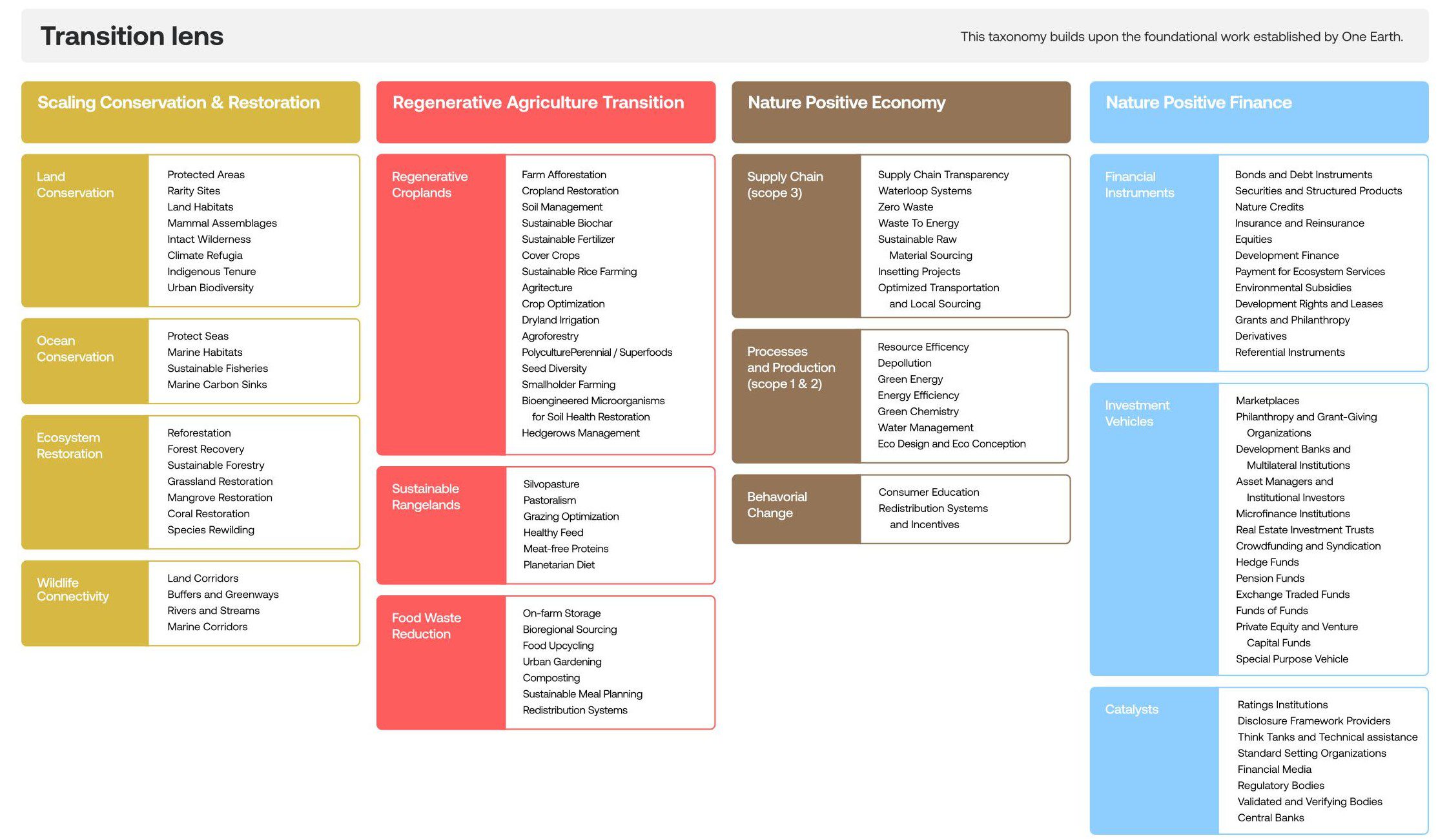
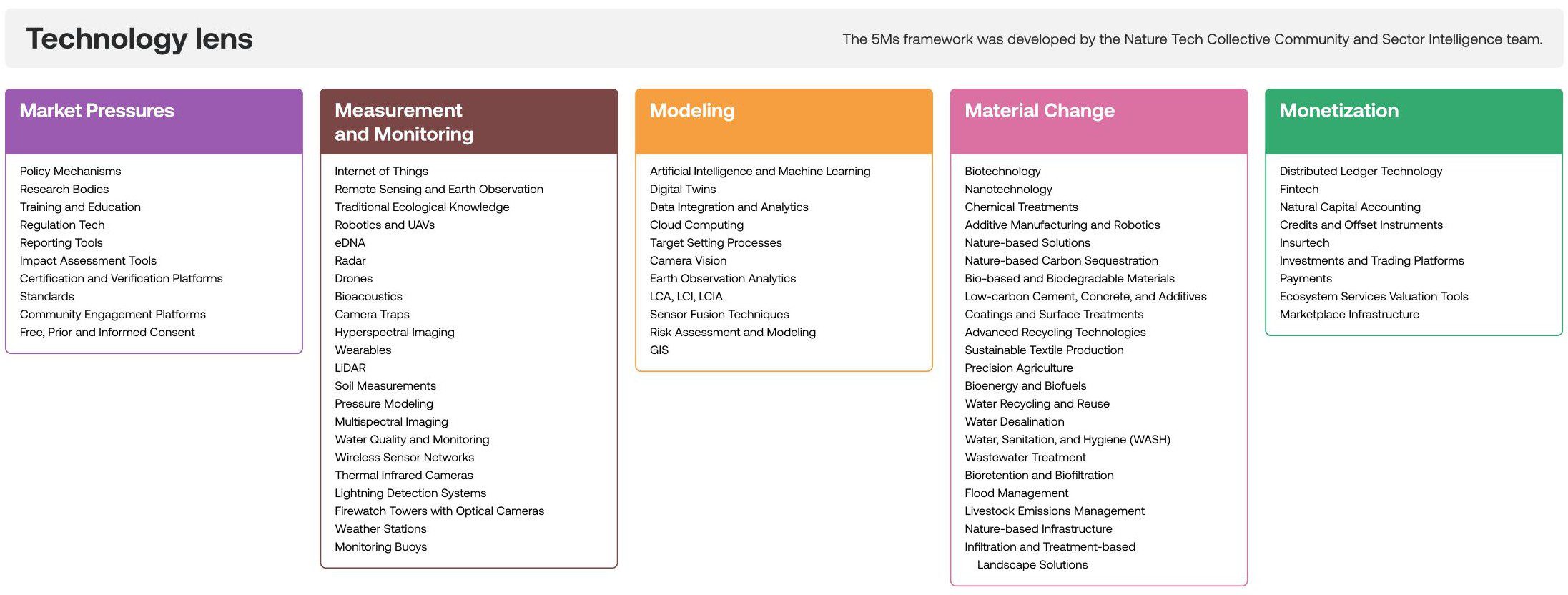
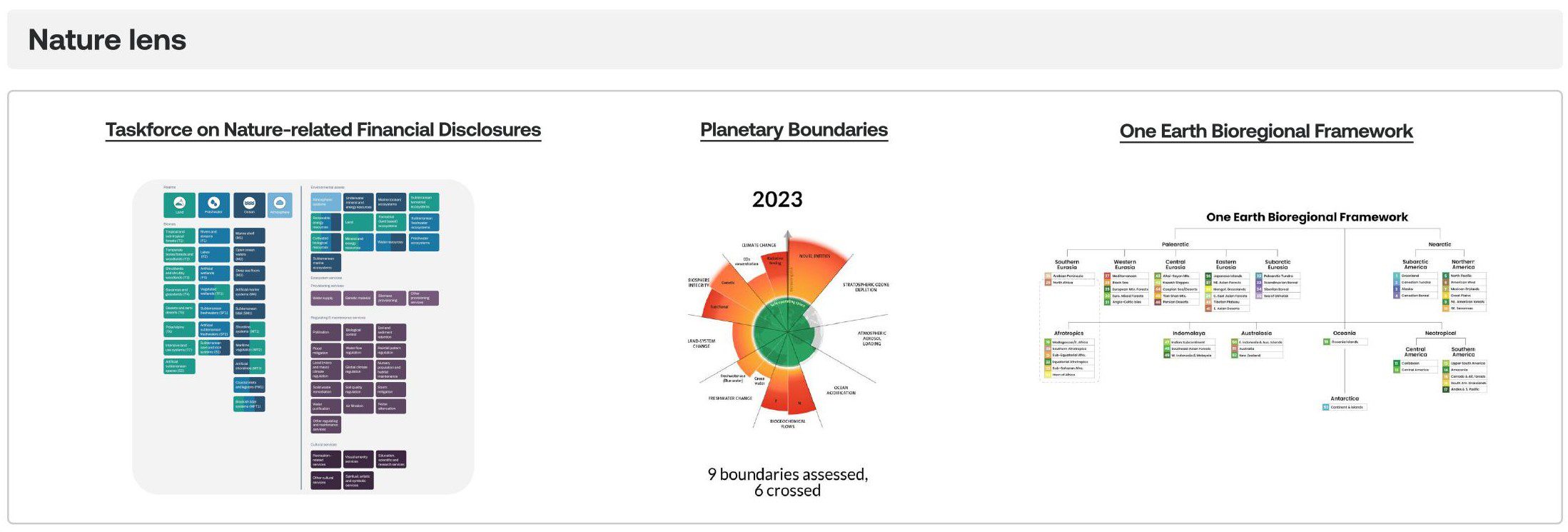
Because Nature Tech is expanding rapidly, the sector has been difficult to navigate, even for experts. That is what motivated the development of the Nature Tech Taxonomy Framework by the Nature Tech Collective and Impact Labs. Instead of treating Nature Tech as a loose collection of tools, the taxonomy organises the ecosystem through three complementary lenses: transition, nature, and technology. This structure makes the landscape intelligible.
1. The Transition Lens
2. The Nature Lens
3. The Tech Lens

Last year, we had a vital discussion with Steffen Müller from Sales Force, Marie-Anne Vincent from Axa Climate, Gilad Goren from NTC and Simas Gradeckas from Bloom Labs, focusing on technology as a catalyst for a nature-positive transition. The conversation highlighted that although there is currently a behavioural divide causing paralysis and resistance to change, “Nature Tech” offers a necessary positive mindset and a call to action.
Ultimately, the panelists argued against the perceived paradox of associating nature and technology, asserting that technology, especially with ethical development and greater on-the-ground data collection, is essential for accelerating the required systemic change in business strategies.
The frontier: from data to decisions to real world impact
Nature Tech holds enormous promise, but technology alone does not solve the underlying problem. The challenge is not only to develop more sensors, more models, or more dashboards. The challenge is to build a coherent system where high quality data, robust frameworks, credible metrics, and science based methods feed into decisions that shift capital, reshape practices, and regenerate ecosystems.
This is why frameworks like the Nature Tech Taxonomy matter. They provide structure and legibility to a landscape that is expanding faster than most organisations can follow. They help avoid two common pitfalls: the techno solutionism that assumes technology by itself is the answer, and the paralysis that emerges when nature is treated as too complex to act upon.
Nature Tech is ultimately not about tools. It is about the capacity to understand, protect, and restore the systems on which all economies depend.
A new architecture for nature positive transformation
The emergence of Nature Tech marks a turning point. It signals a transition from fragmented initiatives to scalable, data driven strategies capable of supporting a global biodiversity recovery agenda.
Its significance extends across sectors:
- For companies, it enables credible measurement and real integration of nature into core strategy.
- For investors, it provides the metrics, transparency, and monitoring needed for nature positive finance.
- For governments, it unlocks evidence based policy, regional planning, and enforcement.
- For communities and ecosystems, it accelerates the shift from extractive to regenerative models.
The next decade will be decisive. Nature Tech can become the backbone of a new economic architecture, one where decisions are grounded in science, aligned with planetary boundaries, and capable of generating both resilience and regeneration.
But harnessing this potential requires deliberate choices: selecting the right tools, contextualising them in ecosystems, and designing interventions that create real ecological outcomes. When these conditions align, Nature Tech becomes not just an innovation category, but a catalyst for a thriving and resilient future.
Sources
Goren, Gilad. Introducing the Nature Tech Taxonomy Framework. Nature Tech Collective (2024).


