In 2014, the UNFCCC’s Biennial Assessment highlighted that there was no single definition of climate finance. Different institutions tracked it differently, but common elements emerged, leading to a converging understanding: climate finance aims to reduce emissions, enhance carbon sinks, and strengthen the resilience of human and ecological systems. In other words, it is not just about mobilizing funds, but ensuring investments deliver real, measurable climate impact.
The scale of the challenge: why Net Zero depends on more than capital
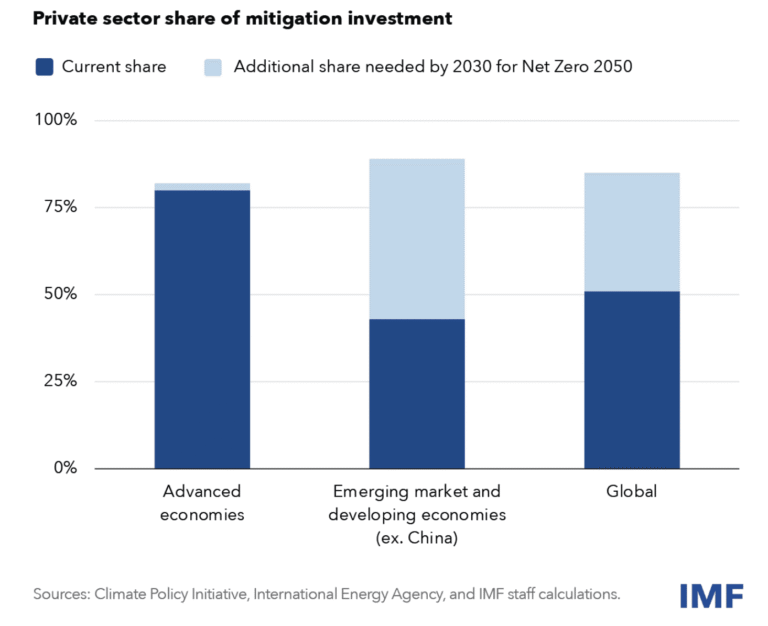
Globally, meeting net-zero by 2050 will require low-carbon investments to surge from $900 billion in 2020 to $5 trillion per year by 2030, illustrating the massive scale of capital that must be mobilized. Emerging and developing economies (EMDEs) alone will need trillions of dollars annually and public climate finance will not be sufficient to meet the 1.5°C target of the Paris Agreement.
To bridge this gap, private actors, including investment funds, corporations, banks, and other market participants, will need to provide an additional 35% of global mitigation investments to keep the world on track for net zero by 2050. In advanced economies, although the climate investment gap is still significant, the private sector is close to reaching the needed share of investment.
Quality of climate finance, not quantity
Over the past decade, global climate finance has grown steadily, but the gap between what is financed and what is needed continues to widen. More importantly, as highlighted in the latest Climate Policy Initiative (CPI) report Tracking the Quality of Climate Finance, the real bottleneck is not only the volume of capital mobilized, but also the quality, effectiveness, and measurability of what gets invested.
CPI’s analysis shows that most climate-related investments still focus on project-level outputs rather than long-term, transformational outcomes. While many institutions track how much they invest, very few measure what these investments actually deliver: avoided emissions, systemic resilience, market transformation, or real climate benefits over time. This lack of harmonized, credible, and comparable impact data results in three major limitations:
- Difficulties in identifying high-impact projects, particularly in early-stage climate technologies or emerging markets.
- Underestimation of climate benefits, because co-benefits, avoided emissions, and long-term system impacts are rarely captured.
- Capital misallocation, as funds struggle to distinguish between impactful climate solutions and initiatives with low or uncertain outcomes.
In other words, finance alone does not guarantee climate impact, quantification does.
From capital deployment to climate performance
This is where Impact Labs steps in. We work with startups and impact funds at two key moments in the investment cycle, providing decision-grade climate data to guide capital toward solutions with real climate potential. In the pre-investment phase, we help investors:
- identify high-impact opportunities,
- assess avoided-emissions potential,
- compare solutions consistently and science-aligned.
After investment, our focus moves to the post-investment phase, where we:
- track climate performance versus expectations,
- quantify realised avoided emissions,
- provide transparent evidence of progress.
On the other side, for startups, we also help them improve and track their impact by showing where they create value, how to increase it, and how to report progress clearly to investors and partners.
Our work at Impact Labs is grounded in a robust avoided-emissions methodology that gives investors a clear and science-aligned understanding of a solution’s real climate potential. We combine technical analysis, credibility checks, and quantified impact estimates to ensure that climate claims translate into measurable outcomes that guide investment decisions before and after capital is deployed.
This methodology follows three essential steps:
- Understand the solution: assessing its differentiation, maturity, and performance versus existing alternatives.
- Verify climate eligibility — ensuring alignment with scientific pathways and mitigation principles.
- Quantify avoided emissions — comparing the solution to a reference scenario to translate impact into clear numbers.
This approach ensures investors know not only which solutions claim impact, but which ones truly deliver it.
Quantification as the foundation of credible climate finance
A practical example of how robust quantification can be embedded into investment decisions is the Climate Dividends model. Under this approach, companies quantify their avoided emissions and, after independent verification, receive one Climate Dividend for every tonne of CO₂e avoided or removed. These dividends are then allocated to investors in proportion to their shareholding, giving them a transparent, audited record of the climate impact their capital enabled. Although not financial instruments, Climate Dividends provide investors with something increasingly valuable: credible, comparable, and externally verified proof of impact that strengthens reporting, reduces greenwashing risk, and enhances the strategic value of climate-positive companies within their portfolios.
While this series focuses on climate, we also consider biodiversity through a complementary framework, offering a holistic view of environmental impact. In upcoming posts, we will dive deeper into both our avoided emissions methodology and biodiversity assessment, showing how these tools help investors make smarter, measurable, and impactful decisions.
Turning finance into measurable impact
Ultimately, the path to effective climate finance is not defined by the volume of capital alone, but by our ability to measure, compare, and prove its real impact. As the world accelerates toward ambitious net-zero targets, investors need transparent, science-aligned metrics that transform climate ambition into actionable investment decisions.
OUR TAKE
This is our conviction at Impact Labs: quantification before investment guides capital toward the solutions capable of delivering meaningful climate benefits, and quantification after investment ensures accountability, credibility, and real progress.
By grounding climate and nature finance in rigorous, verifiable impact data, we can help shift capital to where it creates the greatest value, making the transition not only faster, but truly transformative.
References
UNFCCC Standing Committee on Finance. 2014 Biennial Assessment and Overview of Climate Finance Flows Report. United Nations Framework Convention on Climate Change, 2014.
Simon Black, Florence Jaumotte, Prasad Ananthakrishnan. World Needs More Policy Ambition, Private Funds, and Innovation to Meet Climate Goals. IMF Blog, 27/11/2023.
Sean Stout, Gaoyi Miao, Juliette Allisy and Baysa Naran. Tracking the Quality of Climate Finance: From Theory to Practice. Climate Policy Initiative, 21/11/2025.
Climate Dividends Protocol. The Climate Dividends Initiative.
Images
Image 1
UNFCCC Standing Committee on Finance. 2014 Biennial Assessment and Overview of Climate Finance Flows Report. United Nations Framework Convention on Climate Change, 2014.