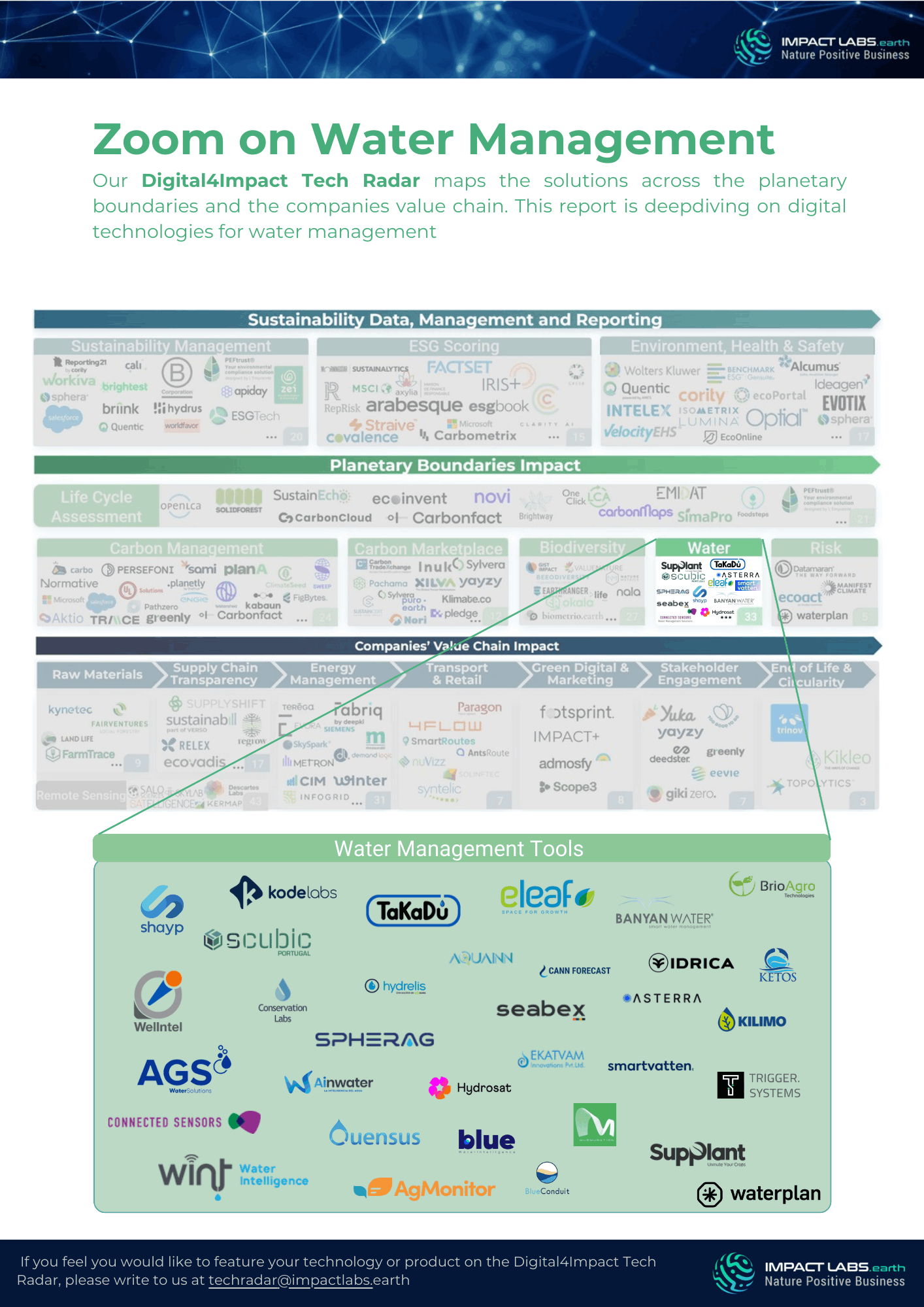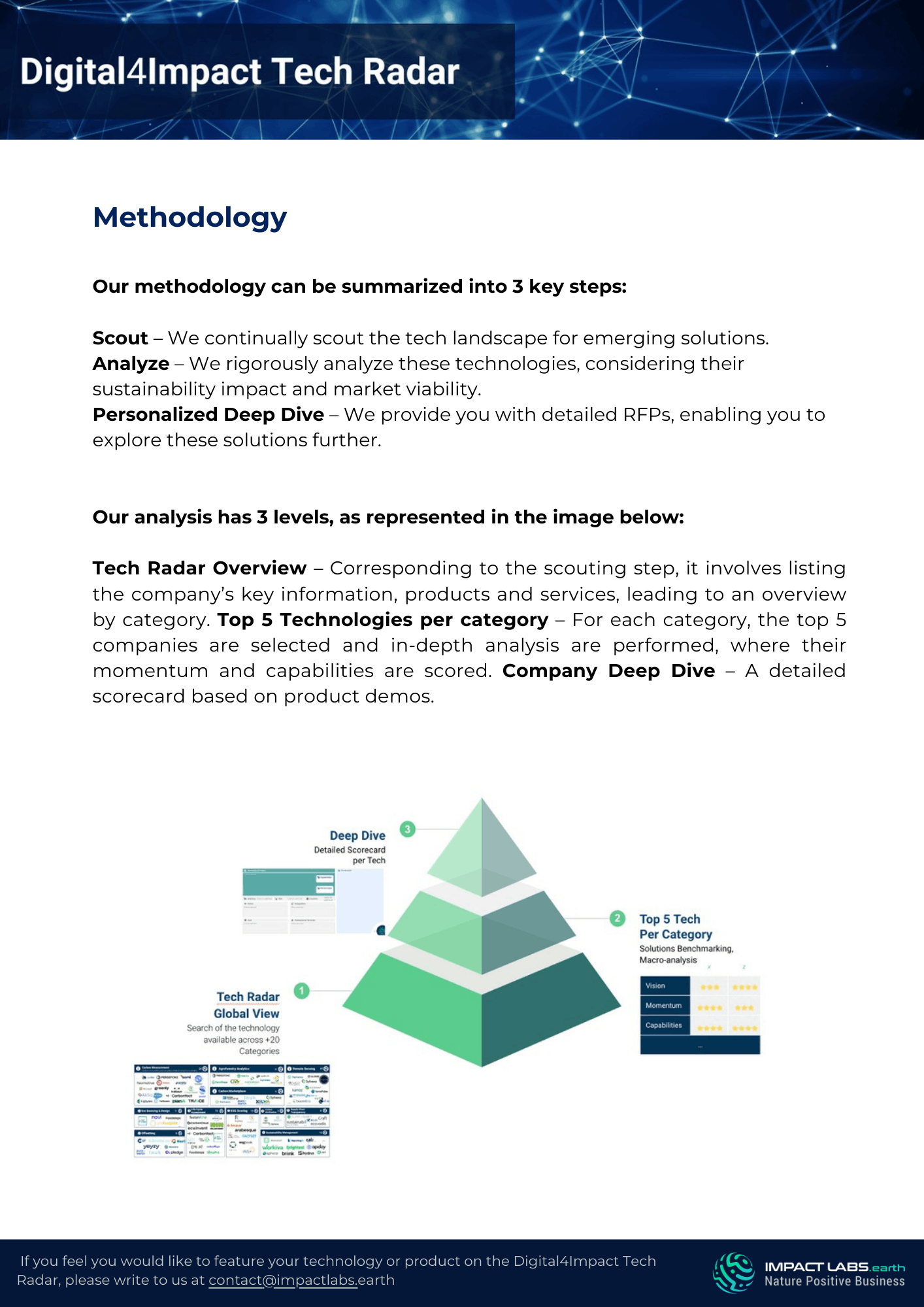
The water technology market has grown considerably over the past two decades. Our Digital4Impact Water Management Tech Radar, published in April 2025, maps the landscape of solutions across these three industries and finds a market shaped by rising investment, regulatory pressure, and an accelerating shift toward data-driven, software-first approaches. What follows draws on that research to give a grounded picture of where the technology stands; and where the most significant opportunities remain.
Water utilities: from reactive monitoring to predictive operations
Water utilities face a compound challenge: aging infrastructure, a workforce approaching a retirement cliff, and rising climate volatility straining distribution networks. The technological response has been significant. Solutions in this space range from AI-driven leak detection and satellite-based infrastructure monitoring to real-time digital twins running continuous hydraulic simulations – enabling operators to shift from reacting to failures to anticipating them. Generative AI is beginning to surface institutional knowledge and automate operational workflows, while cybersecurity has become a non-negotiable design requirement as systems grow more interconnected.
A standout example is Asterra, which uses synthetic aperture radar from satellite to detect underground leaks at city scale, scanning thousands of kilometres of pipeline in a single pass, with no integration into existing infrastructure required.
Maturity level: high on leak detection and operational monitoring; medium on predictive operations and digital twin integration; early stage on AI-driven decision support.
Real estate: from low priority to operational necessity
Water was an afterthought in real estate for most of the past two decades: cheap, largely unmetered, and overshadowed by energy efficiency. That calculus has shifted as water prices rise, regulations tighten, and the financial cost of water damage events grows. Solutions now cover the full building water cycle: sub-meter consumption monitoring, AI-powered leak and anomaly detection, portfolio-level dashboards, flood prevention, and remote shut-off capability. The commercial case is unusually clean, as deployments typically recover their cost within a year through reduced consumption and damage prevention alone.
Shayp illustrates where the market is heading: a non-invasive retrofit onto existing meters, AI anomaly detection, ROI modelling built into the platform, and an average of 22% water savings across its client base.
Maturity level: medium-high on leak detection; medium on comprehensive portfolio management; lower on predictive analytics at scale.
Agriculture: the largest consumer, the hardest to move
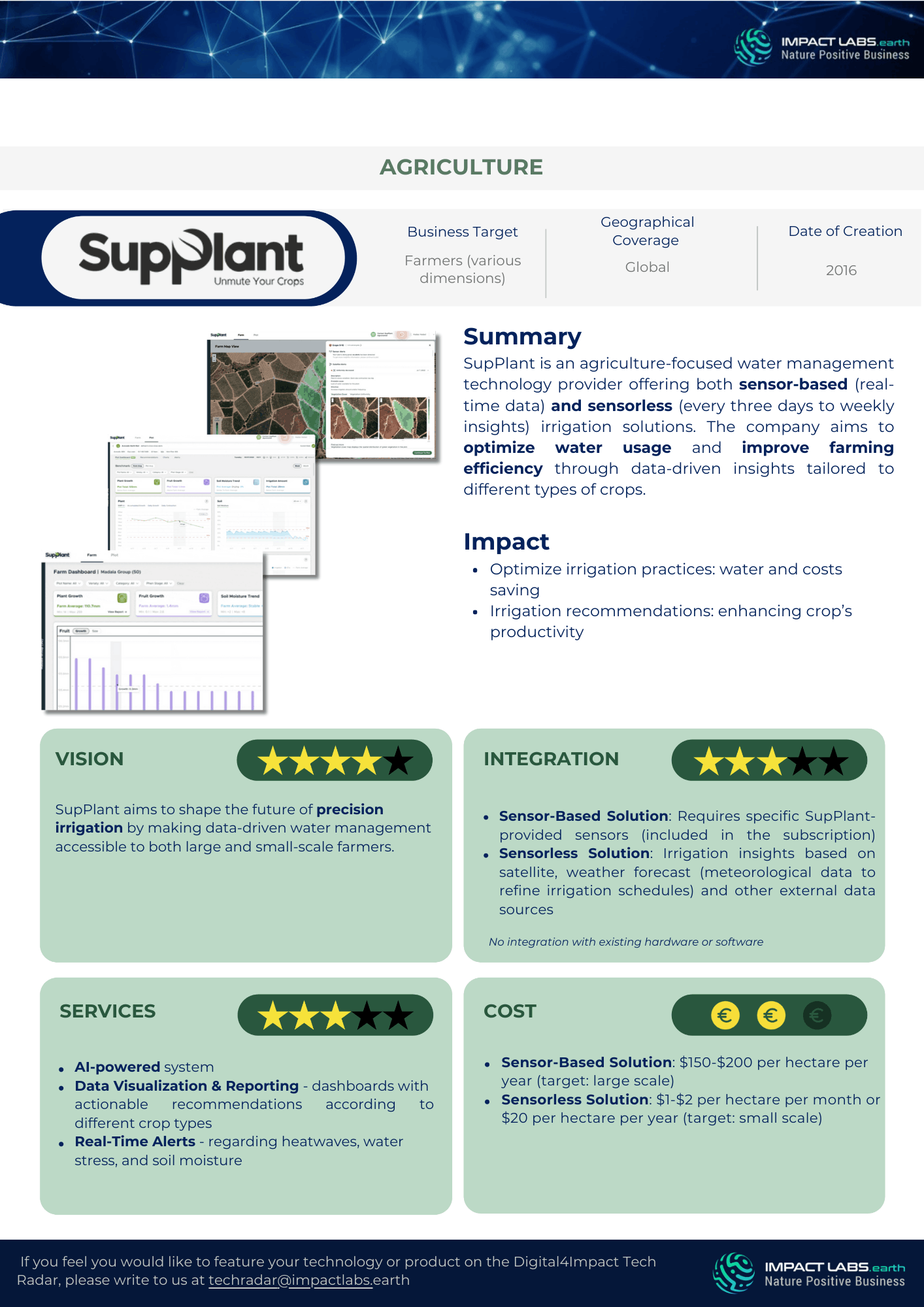
As we’ve seen, agriculture is the biggest contributor to freshwater withdrawals by a long shot. And the gap between best practice and common practice remains the widest of any sector. Solutions span from satellite-based evapotranspiration mapping for water authorities and policymakers, to field-level irrigation scheduling for individual farmers, increasingly without any on-site sensors. The market is converging on software-first, sensorless approaches that are cheaper to deploy, easier to scale, and less dependent on rural connectivity.
Seabex captures this direction well: 95% accuracy in irrigation planning using only satellite imagery, climate data, and AI – no hardware, and with documented water savings of up to 30% and yield increases of 20%.
Maturity level: medium on smart irrigation for larger operations; lower on small-farm accessibility and basin-level integration.
What the landscape tells us
Three themes emerge consistently across all three sectors in our Tech Radar research.
The first is the shift toward software and data over hardware. Solutions that depend on proprietary on-site infrastructure are losing ground to platforms that integrate with existing meters, satellite imagery, and third-party data sources. Reducing the hardware requirement lowers the barrier to adoption and accelerates deployment.
The second is impact measurement as a differentiator. Buyers (whether a utility procurement team, a real estate asset manager, or an agricultural cooperative) increasingly want to know not just whether a solution works, but how much it saved, in litres and in euros. Solutions that can quantify their impact with credible, auditable metrics are winning contracts. This matters for our clients too: the ability to demonstrate water savings in terms that connect to financial and ESG reporting is becoming a procurement requirement, not a nice-to-have.
The third is integration maturity. The best solutions on the market today are those that slot into existing operational infrastructure — existing meters, existing ERP systems, existing reporting flows — without requiring organisations to overhaul their data architecture to get started. API-first, hardware-agnostic design is the emerging standard.
But these trends share a common ceiling. Digital monitoring, however sophisticated, optimises the system as it exists. It reduces waste; it does not rebuild the capacity to absorb it. For that, a different category of solution is emerging – one that operates not on data pipelines but on soil chemistry.
From efficiency to regeneration: the deep-tech shift
The digital solutions above are essential, and for most organisations they represent the right starting point. But water stress is not only a management problem, it is increasingly a physical one. Degraded soils absorb less rainfall. Flash events run off rather than recharge aquifers. The land itself has lost capacity. Addressing this requires interventions that go beyond monitoring and into restoration: bio-based technologies that work with natural systems rather than simply measuring them.
This is the frontier that companies like Biomanity are beginning to open. It is a company we know well: Biomanity is an Impact Labs client, and we have worked alongside their team on impact strategy and roadmap since early 2024.
The Montpellier-based chitosan applications specialist is upcycling crustacean shells – a massive byproduct of the food industry – and turning them into high-performance, petroleum-free polymers that address the root of agricultural water stress.
The innovation: a bio-based super absorbent
Traditional agriculture relies on fossil-based polymers to retain water in the soil. These are non-degradable, contributing to the microplastic crisis that now sees plastics present in the bloodstream of 80% of humans tested. Biomanity’s proprietary technology disrupts this by using chitosan. Their bio-based SAP acts as a “root sponge” with remarkable properties:
- It can absorb up to 200x its weight in water, comparable to petroleum alternatives but without the chemical footprint.
- Unlike fossil SAPs, Biomanity’s product is a biostimulant. As it biodegrades in the soil over 12 months, it releases nutrients that increase plant biomass.
- Validated tests show a 50% reduction in irrigation needs and a 23% increase in average crop yield.
This is the frontier that companies like Biomanity are beginning to open. It is a company we know well: Biomanity is an Impact Labs client, and we have worked alongside their team on impact strategy and roadmap since early 2024.
The Montpellier-based chitosan applications specialist is upcycling crustacean shells – a massive byproduct of the food industry – and turning them into high-performance, petroleum-free polymers that address the root of agricultural water stress.
Does it make financial sense?
The question we apply to every solution in our Tech Radar is whether the impact case and the financial case can be made simultaneously. For Biomanity, the answer is increasingly yes, and the regulatory environment is accompanying it.
The European ban on non-degradable polymers, phasing in by 2028, is opening a $1.5bn agricultural market gap. By securing supply chains from crustacean waste, Biomanity is driving production costs down to compete directly with fossil-based chemistry.
This convergence of environmental necessity, regulatory pressure, and commercial viability is precisely the dynamic we look for when advising clients on where to place their bets in the nature-tech space; and it is what drew us to partner with Biomanity directly as part of our impact acceleration work.
Navigating the full landscape
The solutions covered in this section sit at very different points on the maturity curve, from satellite leak detection that can be deployed this quarter, to bio-based soil polymers that are still in commercial scale-up. For organisations trying to prioritise action, the question is not which technology is most impressive, but which is most appropriate for their context, their sector, and their timeline.
That is exactly what our Digital4Impact Tech Radar is designed to answer. It maps over 50 startups and solutions by technology readiness level, sector applicability, and impact potential; giving our clients a structured starting point for technology selection rather than an overwhelming menu of options. We invite you to explore it alongside this article as a companion tool for moving from insight to action.