

The Nature Tech Collective (NTC) is a global community of nature tech stakeholders, united by a shared mission to accelerate the transition towards a nature positive economy. By crowd-sourcing research & intelligence from a leading network of scientific, solutions & industry experts, the Nature Tech Collective functions as an essential capacity builder for the nature positive transition.
Impact
All industries to drive change at scale
United States
There are multiple reasons why a Taxonomy for Nature Tech solutions is needed:
Scale and Urgency: Environmental degradation and biodiversity loss are occurring at an alarming rate, with significant economic risks.
Nature-Finance Gap: There is a substantial annual gap of 700$bn in nature-related financing, hindering large-scale implementation of solutions.
Fragmentation: Lack of coordination among stakeholders limits the potential for collective problem-solving.
Rapidly Changing Market: The evolving nature tech sector requires a shared understanding and framework to keep pace with new solutions and regulations.
We need a taxonomy for nature tech for several reasons:
Shared Language and Understanding: A taxonomy provides a common framework and language to describe the various needs and solutions within the nature tech sector, facilitating better communication and understanding among stakeholders.
Ease of Navigation and Exhaustivity: It helps stakeholders navigate the complex landscape of nature tech solutions, enabling them to identify the right technologies and solutions for their specific needs.
By delivering a comprehensive view of available nature tech solutions, a taxonomy helps stakeholders identify where a critical mass of providers exists, and recognize gaps in the market.
Mainstream Adoption: a taxonomy aids in achieving mainstream awareness and adoption by providing a structured and systematic approach to categorizing and understanding the solutions and stakeholders involved.
Support for Decision-Making: It assists in making informed decisions by categorizing solutions according to different dimensions such as technology, transition needs, and geographical context, thereby supporting the selection and deployment of nature tech on a global scale.
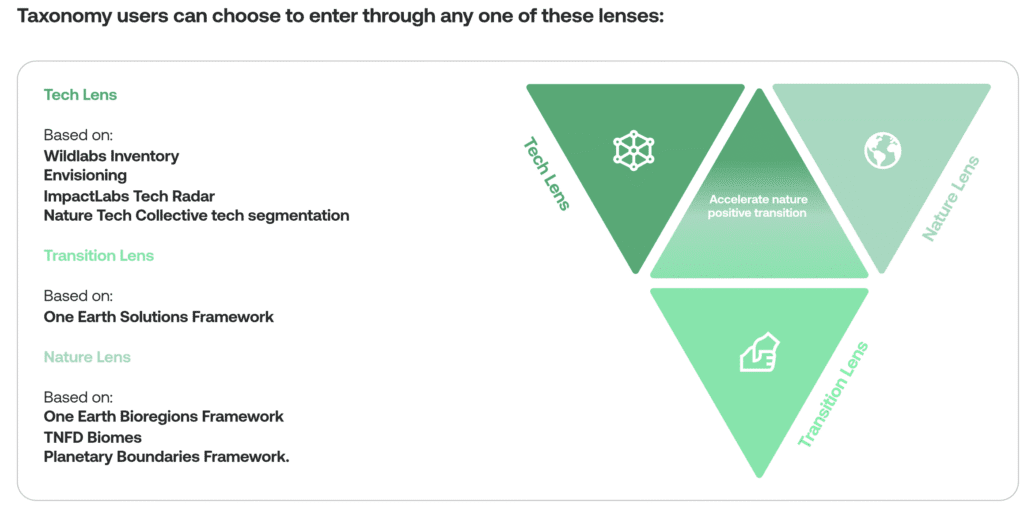
The taxonomy is structured around three complementary lenses:
Transition Lens: Highlights four critical transitions required for a Nature Positive shift, emphasizing systemic changes to restore ecosystems, reduce environmental harm, and build long-term resilience.
Nature Lens: Maps ecosystems and biodiversity complexity using reference frameworks such as One Earth Bioregions, TNFD Biomes, and Planetary Boundaries.
Tech Lens: Provides an inventory of technologies and levers that can accelerate the Nature Positive transition, supporting scalable and effective implementation of solutions.
Specialist consultations: We held consultations with organizations and companies such as One Earth, Bloom Labs and Vibrant Data Labs, providing valuable insight into the needs of different players across the nature tech sector.
Market research: We conducted research into current understandings of ‘nature’ and ‘tech’, the intersection of the two, and the boundaries of what is considered ‘nature tech’.
Community workshops: By consulting the Nature Tech Collective Community during the development of the taxonomy, we gathered early insights and feedback response on the proposed structure of the taxonomy and categorizations. This helped us select the categorizations we felt were most understandable to a broad group of stakeholders – Governments, NGOs, academics, businesses, project developers, financial institutions and nature tech solution providers.
Sustainability expertise
Impact Labs’ experience in developing the proprietary Digital4Impact Tech Radar, a tool that maps emerging technologies and their capabilities across the sustainability value chain, helped inform the development of the taxonomy framework and guide the process.
The Nature Tech Taxonomy Framework aims to:
Accelerate Nature-Positive Transition: By providing stakeholders with tools to implement effective nature-positive initiatives.
Enhance Coordination: Facilitating better collaboration among NGOs, companies, financial institutions, and other stakeholders.
Improve Decision-Making: Offering a comprehensive view of available solutions to help stakeholders make informed choices.
Support Financial Viability: Enabling the identification of new financing mechanisms and investment opportunities for nature-positive projects.