Starting a Virtuous Circle: Leveraging AI to Report On Your State of Circularity
Every year, major consumer goods companies face the same question: how can they reduce their impact on the planet with their high volume of product sold? A part of the answer, especially for packaging, resides in recycleness, recyclability or refillability. For one of the world’s leading FMCG players, answering that question at a global scale meant confronting a data problem as much as a sustainability one.
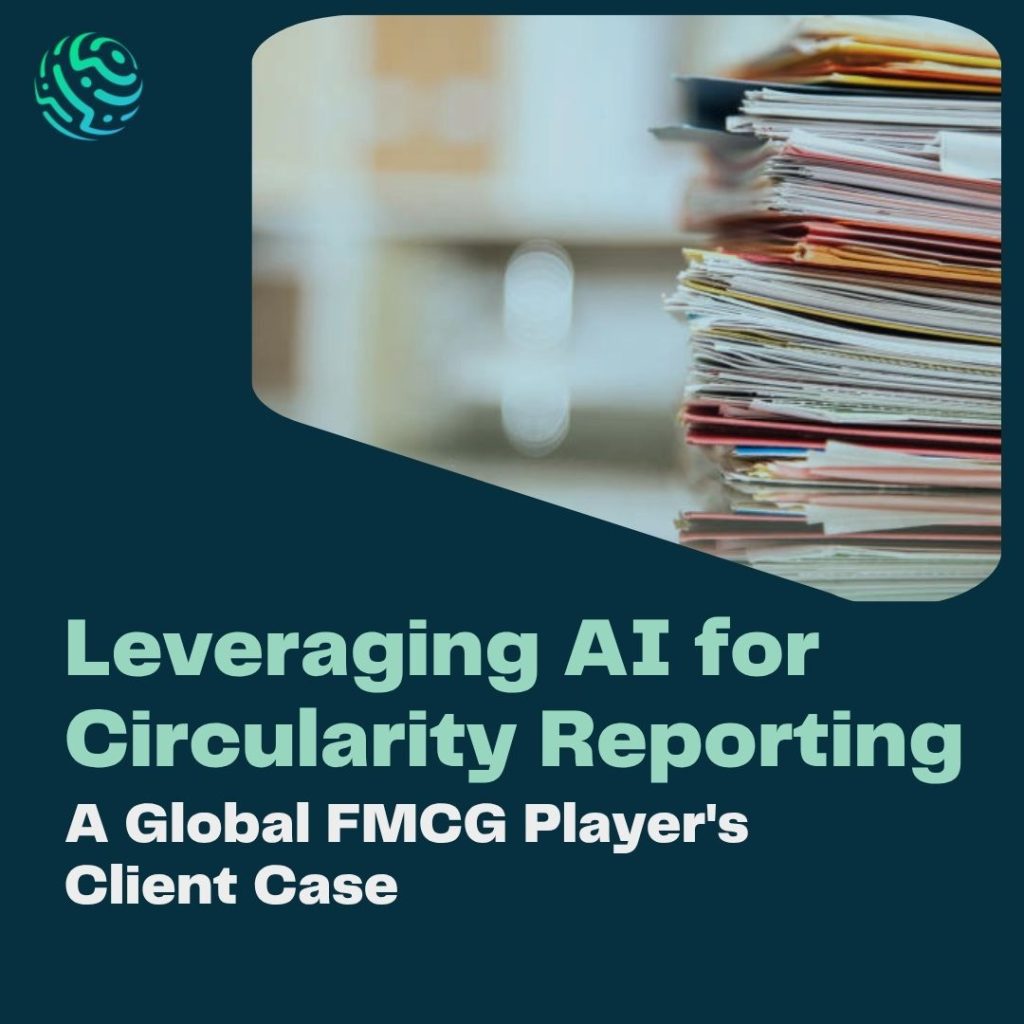
This company reports its circularity performance annually, tracking the recyclability potential of its packaging and the share of recycled materials it puts back into circulation. The ambition is clear. The execution, until recently, was not. The data underpinning these numbers had to be pieced together manually, country by country, material by material.
Companies reporting on circularity generally have two paths: track proprietary data across their own operations, or draw on public recycling and recovery statistics where their own data isn’t available. A good way to get started is to use public data, which our client relies heavily on. Think of it as using monetary emission factor for calculating your Scope 3: it is a great way to get started in understanding your impact and identifying priorities.
The problem is that public data is scattered, inconsistent, and constantly shifting. Recycling rates for the same material can range wildly from one country to the next. Sourcing, verifying, and updating this information year after year, market after market, was consuming enormous manual effort for a task that should, in principle, be systematic.
The challenge was clear: automate the retrieval of this public data, without sacrificing the rigor their reporting demands.
Enter AI: From Manual Research to Intelligent Automation
We partnered with the client to build an AI-powered system that could do what a research team previously did by hand – only faster, more consistently, and with a built-in trail of evidence behind every number.
Rather than letting AI loose to search freely (and risk the kind of confident-but-wrong answers language models are known for), the system was engineered with strict guardrails: clear hierarchies for which sources to trust first, fallback logic for filling gaps without guessing, and a scoring mechanism that flags exactly how reliable each data point is, based on how local and how recent it is.
The result is a pipeline that mirrors how a rigorous analyst would work, at a speed and scale no analyst could match alone.
Why This Matters Beyond One Company
Operationally, applying CTI follows a seven-step cycle:
- Scope – define the boundaries of the assessment (whole company, business unit, product line, timeframe)
- Select – choose which indicators from the menu are relevant to the objectives
- Collect – gather the underlying data, often the most labor-intensive step, sometimes requiring value-chain partner cooperation
- Calculate – run the formulas for each selected indicator
- Analyze – interpret results against context (mass of flows, industry benchmarks, performance over time)
- Prioritize – rank identified linear risks and circular opportunities using threat/vulnerability scenario analysis
- Apply – set SMART targets and roll out actions, feeding back into the next assessment cycle
It’s increasingly used alongside broader sustainability reporting and helps organizations track progress over time.
And these frameworks are truly essential, but they’re only as good as the data feeding them. And for global companies operating across dozens of markets, that data has always been the hard part. What this project shows is that AI, applied with the right discipline and constraints, can finally close that gap.
We know that pollution isnt exclusively what leaks into rivers or piles up in landfills, it’s what happens when materials never make it back into the system at all, and virgin resources get extracted to replace them. Every gap in circularity data is, in effect, a blind spot in the efforts against waste and pollution: companies can’t close the loop on materials they can’t see or measure.
That’s what makes this project bigger than an efficiency story. By making circularity reporting scalable, defensible, and repeatable, AI turns what was once a research bottleneck into infrastructure that lets a global business actually track (and act on) where materials leak out of the system.
As more FMCG players face mounting pressure to report on packaging circularity and material recovery, this project is a preview of where the industry is headed: AI making rigor achievable at global scale, so that tackling pollution starts with knowing precisely where the material is going.
References
World Business Council for Sustainable Development. Circular Transition Indicators (CTI).